This post (again, from Jenn, Susan's daughter) is a thank-you letter to all those who have
listened, or will listen, to those who have lived adoption. Those who do so
with an open heart and mind are hard-pressed not to be moved, but at the same
time I recognize how difficult it is to change one’s own beliefs, especially if
those beliefs are deeply held and reinforced by cultural myths perpetuated in
movies, TV shows, magazines … in short, almost everywhere. I also recognize just how busy with
their own important affairs people are, and how hard this issue can be to
understand (at first). So thank you, those who have listened, or will listen.
Please bring your questions, your doubts, your fears … but also your open heart. Prepare
for an awakening. I know that’s how it felt for me, as I spoke with my mom and
thought deeply about adoption for the first time.
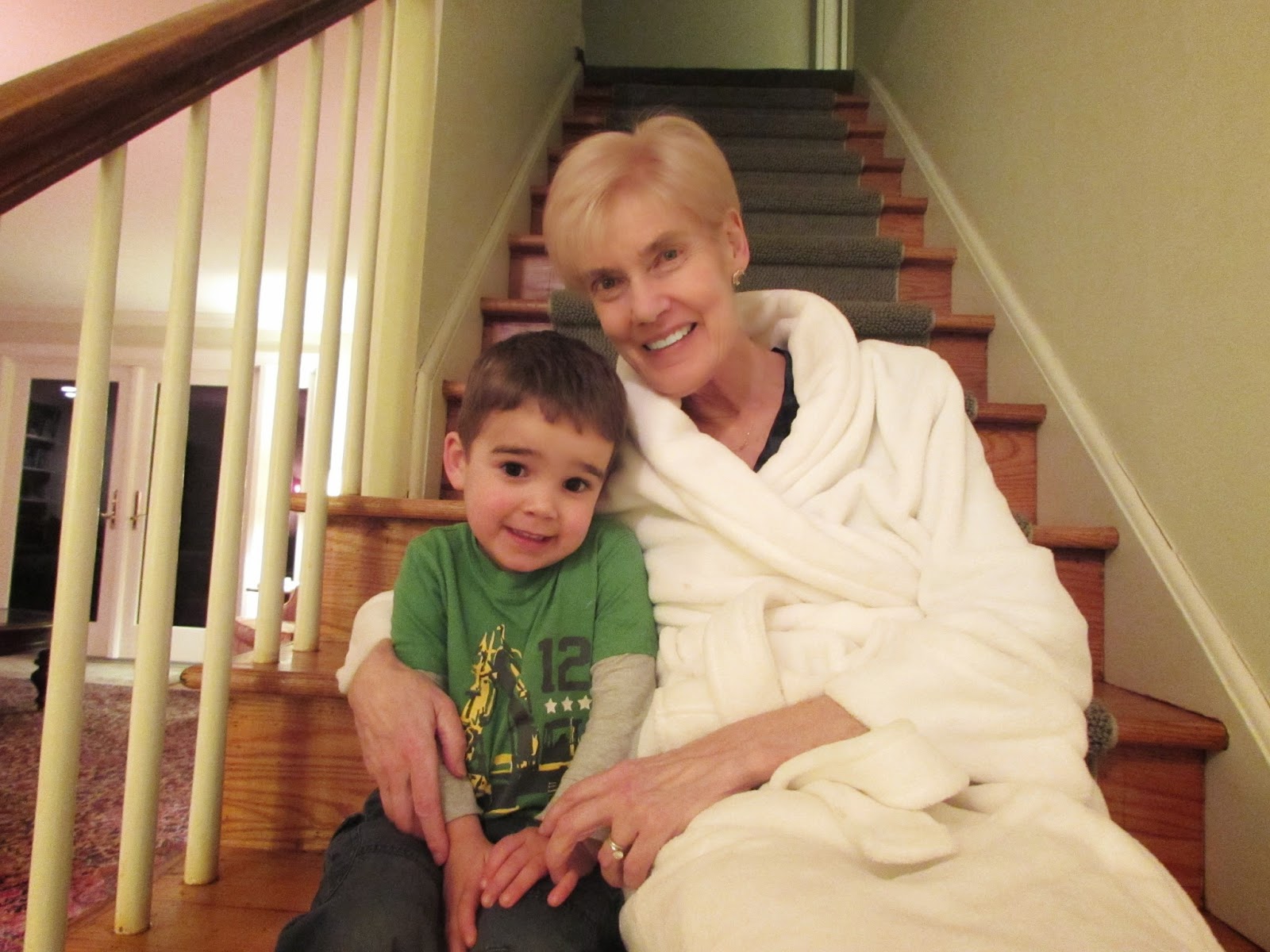 |
| This photo, of my mom and my son Joseph, is from February 6th, after my mom, dad, and I had just had a good laugh as I attempted to color and style her hair, and almost turned it red. Going to the salon was just not possible at this point. I know now that my mom asked me to do her hair to create a memory (she certainly didn't ask me for my skills). I love her, and thank her, for that. |
I especially want to thank Senator Diane Allen, who has
tirelessly championed the Adoptees Birthright Bill (S873/A1259) in New Jersey
and carefully listened to hours of testimony from original (birth) parents,
adoptees, and adoptive parents for over 10 years. I am hoping that in the
next month I will be able to thank New Jersey Governor Chris Christie, who
despite previously opposing this bill and calling for intermediaries (they don’t
work, and are insulting to adoptees), will listen to Senator Allen and hear her compelling case for why this bill should be signed into law. Though
many, many others have worked for years, even decades, for adult adoptees’
access to their original birth certificates, in my heart if this law passes in
NJ I will consider it “Susan’s Law,” after my mom, who first got me to listen,
and to reconsider my own views.
I also want to thank my dear brother-in-law, Harry. This
past February I was at my nephew’s (his son’s) 12th birthday party,
and as we served ourselves dinner from the dining room table buffet, he said,
“That was an interesting article on your mom, Jenn.” He was referring to the
front page February 23rd Philadelphia Inquirer article, Bills in Pa., N.J.. would open adoption
records, which featured a picture of me, my mom, and my daughter Grace (http://articles.philly.com/2014-02-23/news/47607101_1_adoption-records-adoptees-original-birth-certificates
). The article covers all the reasons that advocates have been fighting for
adoptees’ access to their original birth certificates, but it also includes a
few quotes from those who oppose this access, namely Mary Tasy from NJ Right to
Life and Patrick Brannigan from the NJ Catholic Conference. Though the article
mentions that the NJ Bar Association and the NJ ACLU also oppose the law,
nobody from these organizations spoke out. Harry, who I respect immensely and
always love talking to, because he is thoughtful, well-read, educated, and
open, went on, “I guess there are some really interesting points on both
sides.”
At that point, I froze. My mom, who passed away April 7th,
was at that time gravely ill, in part because of a lack of access to her full
medical history, and the issue was just so personal. But I took a deep breath,
explained the issue as calmly as I could, and Harry simply said, “Oh, that
makes a lot of sense. I guess I just never thought about any of this before.”
Most people who haven’t lived adoption are in the same boat. I am always glad
when these people ask questions, or engage on the issue.
 |
| My sister Kate, my mom, and her sisters, Carol and Jo, having lunch at my parents' house in December. Those arguing for adoption reform: Adoptees, original families, and adoptive parents. They are the only "side" that should be considered. |
Many times over the past two months I have come back to my
brother-in-law’s comment, though, because if he (a well-educated, highly
intelligent, deeply compassionate person, not to mention a psychologist with a
PHD) could so easily be misinformed, how could others not be? “It seems like
there are compelling arguments on both sides of the issue,” he said.
Yes, those who just read the press coverage of this and
don’t deeply engage might be left with that impression but, let me state
clearly, there are not two sides to
this issue, any more than there were “two sides” to the issues of abolishing
slavery, giving women the right to vote, or desegregating schools. A sampling
of those who spoke out in favor of those
injustices:
Some defenders of slavery (and there
were many) argued “that the institution was divine, and that it brought
Christianity to the heathen from across the ocean, Slavery was, according to
the argument, good for the enslaved” (www.ushistory.org).
Those who opposed giving women the
right to vote were also, for years, given a voice in the debate (and they, of
course, had the louder voice). “You do not need a ballot to clean out your sink
spout!” read a pamphlet put out by the National Association Opposed to Women
Suffrage in the 1910s, which also offered housecleaning tips. Another reason given: “For it is unwise
to risk the good that we have for the evil which might occur.”
Finally, those who fought
against desegregation came up with all kinds of arguments to support their
case. One of the most prominent lawyers to defend segregation, James Lindsay
Almond Jr., the state attorney
general of Virginia, claimed that segregation was just because “with the help
and sympathy and the love and respect of the white people of the South, the
colored man has risen...to a place of eminence and respect throughout the
nation.” (www.si.edu.brown/history/5-decision/defenders
)
In their day, all of these
points were considered debate-worthy, and these issues were considered highly controversial, just as adult adoptees access to
their original birth certificates is sometimes presented as a “controversial
issue” in the press today. But it is not. The arguments of all those who oppose
this law are just as myth-filled, fear-based, and flat out wrong as the
arguments listed above.
Are you here to listen, to learn, to consider your own
previously held beliefs? Then I welcome you, and I thank you. Do you not yet
see how this is a clear-cut issue of social justice, one that does not have two
sides? Then I ask for your comments, and your questions. I (or perhaps someone
even better informed than I am from the adoption community) would love to address
them. I consider it a way to honor my mom, Susan Perry, who didn’t get to live
to see this change come, but who fought so hard to see that it did.
